River fishing for salmon
A step by step guide on how to float fish for salmon. For a more in depth lesson, our in-person classes are excellent for beginners.
It is important to note that in ALL rivers and lakes across British Columbia, salmon and steelhead fishing must utilize BARBLESS SINGLE hooks. Please check regulations.
Salmon fishing in rivers have many different methods and styles that work, however the all around general method that consistently produces fish is float fishing. In this tutorial, we will walk you through the characterics your gear should have, how to rig it and how to fish it.
Rod and reel
Rod Selection
For most river salmon fishing situations, a rod between 9 and 11 feet long is ideal. The extra length provides better line control, longer casting distance, and can keep your mainline out of the water and in direct contact with the float, for minimal delay when you hookset.
A rod medium-heavy rated for 10–30 lb line is suitable for most beginning salmon fishermen. Medium-heavy has the flexibility needed for smaller salmon, like pinks, but with the power needed for larger salmon like chinooks. For beginners who don't want to break the bank and purchase multiple rods, the President XT Casting rod would be a good example of a sturdy but flexible rod, rated medium-heavy and 10 feet long.
Reel Selection
Float fishing in rivers requires your float to drift down the river. The best reel for this action would be a bait-casting reel with a one button bail that releases line smoothly, compared to a spinning reel. While slightly more difficult to learn with, the benefits are incredibly higher, such as minimal delay in setting the hook.
A low-profile baitcasting reel with a line capacity between 150 yd to 250 yd would be ideal, with a handle large enough to have some power while reeling in these hard fighting salmon.
The Shimano Caius low profile baitcasting reel would be an excellent choice for a beginner salmon fisherman, while not skimping out on quality but also not breaking the bank.
Line
There is debate on different types of line, however we recommend and personally use 20–30 lb braided mainline paired with a 12–15 lb fluorocarbon or monofilament leader. Braided line offers excellent sensitivity, power and casting distance compared to a monofilament mainline.
Necessary Tackle
15-25g float/bobber
15-25g egg weight to match the float
Float stops
Beads
Snapswivel
Barrel Swivel
12-15lb Fluorocaron / Monofilament leader
Size 1-2 Barbless Hooks
Baits/Attractants
8-14mm Soft/Hard Beads with pegs (General colours are red, pink and orange)
Cured salmon roe
Shrimp
Jigs
Theory behind the bite
When salmon enter fresh water from the ocean to begin their journey to spawn, they stop eating and swim using their remaining fat storages. So how will they bite? During this journey in fresh water, salmon become aggressive and will bite and destroy salmon eggs either to deter predators from approaching or to lower the competition for their own offspring. Salmon will also bite lures that annoy them, however in float fishing we will focus on their egg crushing instincts. Taking advantage of this, the 2 main baits that are used are cured salmon roe and soft/hard beads, which mimic individual salmon eggs.
How to rig it
The Mainline
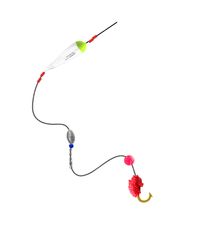
Step 1: Thread on a Float Stop
Start by threading a float stop onto your mainline. The float stop determines how deep your bait will fish and can be adjusted. We personally like to thread 2 on.
Step 2 Add the Float
Thread your float onto the mainline.
Step 3: Thread on another Float Stop
Thread another 2 float stops onto your mainline, where the float should be sandwiched between the top and bottom float stops.
Step 4: Add your corresponding weight
Slide an egg weight which corresponds to the size of the float onto the mainline.
Step 5: Add a bead
Thread a hard bead onto the mainline. This bead protects the knot which will be tied below from the weight constantly smashing into it.
Step 6: Tie a snap swivel at the end
End the mainline by tying on a snap swivel.
The Leader
Leave the mainline with your rod and reel. Tying the leader will require your fluorocarbon/monofilament, hooks, a barrel swivel and soft/hard beads if wanted.
Step 1: Cut a portion of the leader line about 12 inches long
The length of leader should be about the length of your forearm, from your elbow to the tips of your fingers.
Step 2: Tie a Baitloop knot on your hook
Taking this length of leader line and a hook, tie a baitloop knot. This specific knot is very important and is crucial to catching salmon. Videos on how to tie it can be found on YouTube.
Step 3: Add soft/hard bead (Optional)
If you are planning on fishing with beads as the attractant, then first slide a bead peg down the leader to about 3 fingers width from the hook. Then slide the bead of choice onto the leader as well and ensure it sits snug on the bead peg.
Step 4: Tie a barrel swivel at the end of the leader
Using the tag end (end opposite of the hook) tie on a barrel swivel.
Step 5: Final Step, attach the barrel swivel to the snap swivel
Open the snap swivel by opening the end with the switch. Then attach the barrel swivel from the leader and close the snap swivel.
You are now ready to begin fishing.
If you choose NOT to add a bead but rather to fish with roe, here are the next steps from step 5.
Step 6: Pull gently towards the hook on the leader at the hook portion
This will create a nice big loop (hence the name, baitloop knot)
Step 7: Cut a portion of your cured roe
Cut a piece of roe about the size of a quarter.
Step 8: Put the piece of roe into the loop
Put the piece of roe into the loop and cinch down, but not too tightly.
You are now ready to fish
Tips and How to fish it
Depth
Before you have your first cast, you need to set your float depth. Ideally, you want your bait to be about 6 inches off the bottom, so move both the top and bottom float stops accordingly.
Water type
Float fishing typically shines in deep holes where fish like to rest before continuing upstream. Float fishing with roe works in any speed of water, as long as its not in a rapid. Float fishing with beads typically only works if theres at least current at walking speed.
Time slot
The best time to go fishing for salmon is at first light. This is when the fish are still undisturbed by other anglers and are the most aggressive.
Bead sizes
The size of beads range from 6mm to 32mm, however we find the best sizes are between 8-14mm. In dirtier or murky water, use larger beads so the fish have an easier time seeing. In the contrary, in super clear water, use the smallest beads you have, such as an 8mm paired with light leader (10-12lb).
What to do
Cast upriver and let your presentation drift naturally through the run with your thumb hovering over the spool. If your float shows any suspicious movement, whether it wiggles, moves up, lies flat or fully sinks under, press down on the spool firm and lift up. This sets the hook into the fish's mouth and the fight begins. Remember to always adjust everything. This includes the depth you have set, the colours and sizes of beads you are using and newer pieces of bait after a few casts.